Updated · How we check facts
Si Moussa and the first residence
The first house, founded in 1866, already held the large riad, the northern courtyard and their annexes. An inscription in the two rooms on either side of the garden dates them to 1866–67. This is the core that Ba Ahmed would later absorb into a much larger residence.
Ba Ahmed builds Bahia
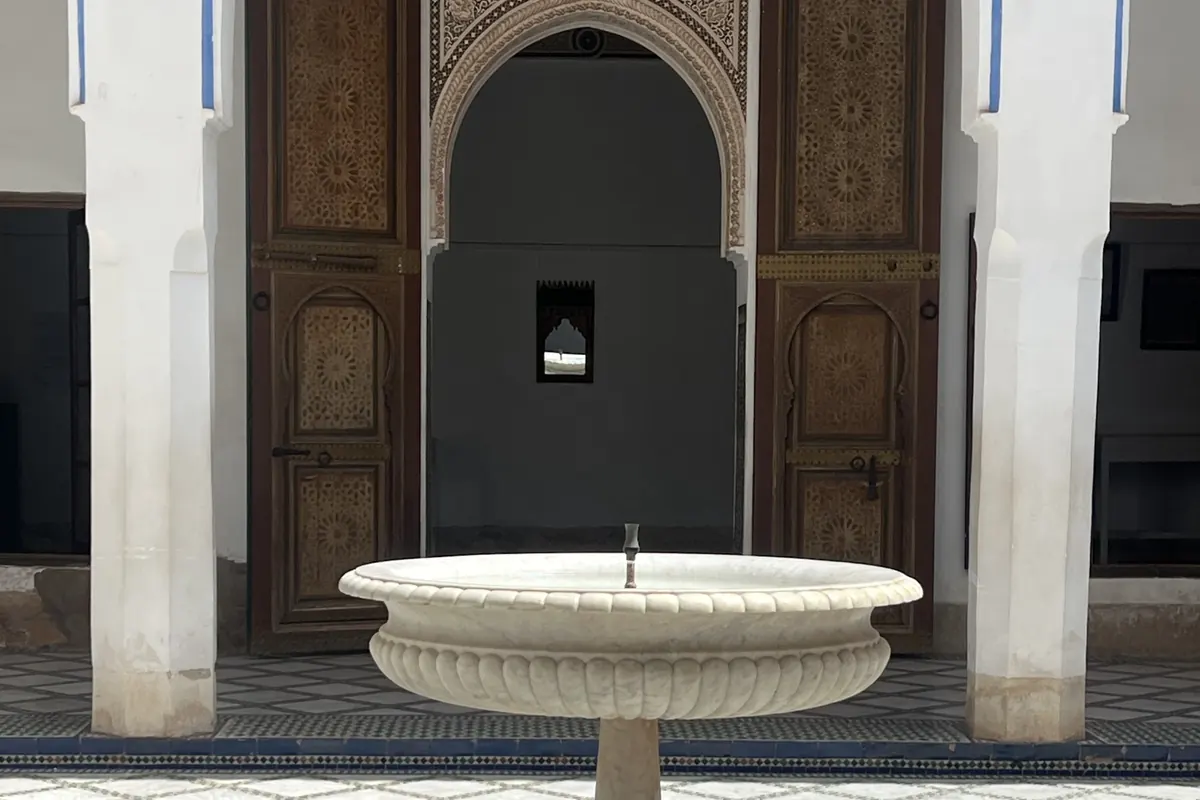
Beginning in 1894, Ba Ahmed acquired neighbouring houses and connected them into a palace of courts, salons, gardens and service spaces. The work continued until 1900 under master builder Mohammed Ben Mekki Mesfioui.
From residence to monument
During the French Protectorate the palace served the Resident General in Marrakech. After independence it entered the Royal Domain, then opened to the public in 1998 under the Ministry of Culture as a protected historic monument.
How separate houses became one palace
Bahia was never planned as one building. Ba Ahmed bought houses next to his father’s residence and had them joined into one palace of courtyards, gardens, salons and annexes. The name is said to mean “the brilliant”.
The work had a named author. The Ministry’s 2025 report credits the enlargement to Mohammed Ben Mekki Mesfioui (1857–1926), an architect and master builder known for his command of the traditional crafts. Over six years he enlarged the Grand Riad and added the Petit Riad, the small marble court, a private pavilion and the annexes.
Ba Ahmed died in 1900, the year the work ended. According to accounts, the palace was stripped of its valuables within hours, on the sultan’s orders.
The palace changed role three times in the twentieth century. From 1912 it housed the French Résidence générale in Marrakech under Lyautey. After independence it passed to the Royal Domains, and in 1998 it opened to the public; the Ministry’s 2025 report records both steps. The Ministry of Culture looks after it as a historic monument, in the report’s words “in accordance with the dahir of 21 December 1924”.
The earthquake of 8 September 2023 destabilised several parts of the palace. By November 2025 most of them had been consolidated, and restoration was still under way, so some rooms or courts may be closed when you visit. Before you go, check the Ministry’s official ticket portal, linked at the end of this page, for current visiting arrangements. Last checked: 8 October 2026.
Questions visitors ask
When was Bahia Palace built?
In two phases in the second half of the nineteenth century: Si Moussa’s house was founded in 1866, and his son Ba Ahmed enlarged it into a palace between 1894 and 1900.
Who built Bahia Palace?
Si Moussa ordered the first house. Ba Ahmed ordered the enlargement and entrusted it to the architect and master builder Mohammed Ben Mekki Mesfioui.
Who was Ba Ahmed?
Si Moussa’s son: chamberlain, grand vizier and regent for Sultan Moulay Abdelaziz. He died in 1900.
What happened to the palace when Ba Ahmed died?
According to accounts, it was stripped of its valuables within hours of his death, on the sultan’s orders.
What does “Bahia” mean?
The name is said to mean “the brilliant”.
What was the palace used for under the French Protectorate?
From 1912 it was the seat of the French Résidence générale in Marrakech.
When did Bahia Palace open to the public?
In 1998, after a period as part of the Royal Domains. The Ministry of Culture looks after it.
Is Bahia Palace a UNESCO World Heritage Site?
It stands in the Medina of Marrakesh, inscribed in 1985, and UNESCO names it among the masterpieces that justify the listing.
Was Bahia Palace damaged in the 2023 earthquake?
Yes. Several parts were destabilised. By November 2025 most had been consolidated and restoration was continuing.
Sources for this page
- Ministry of Culture, Bahia Palace ticket portal
- Ministry of Culture report to UNESCO, November 2025: p. 16 for the history, the Royal Domains and the 1998 opening; pp. 17–22 for the restoration
- UNESCO World Heritage List: Medina of Marrakesh
- Gaston Deverdun, Marrakech: des origines à 1912 (1959), pp. 540–545, cited in Wikipedia
- Quentin Wilbaux, La médina de Marrakech (2001), p. 289, cited in Wikipedia