Updated · How we check facts
Why the courtyard feels so large
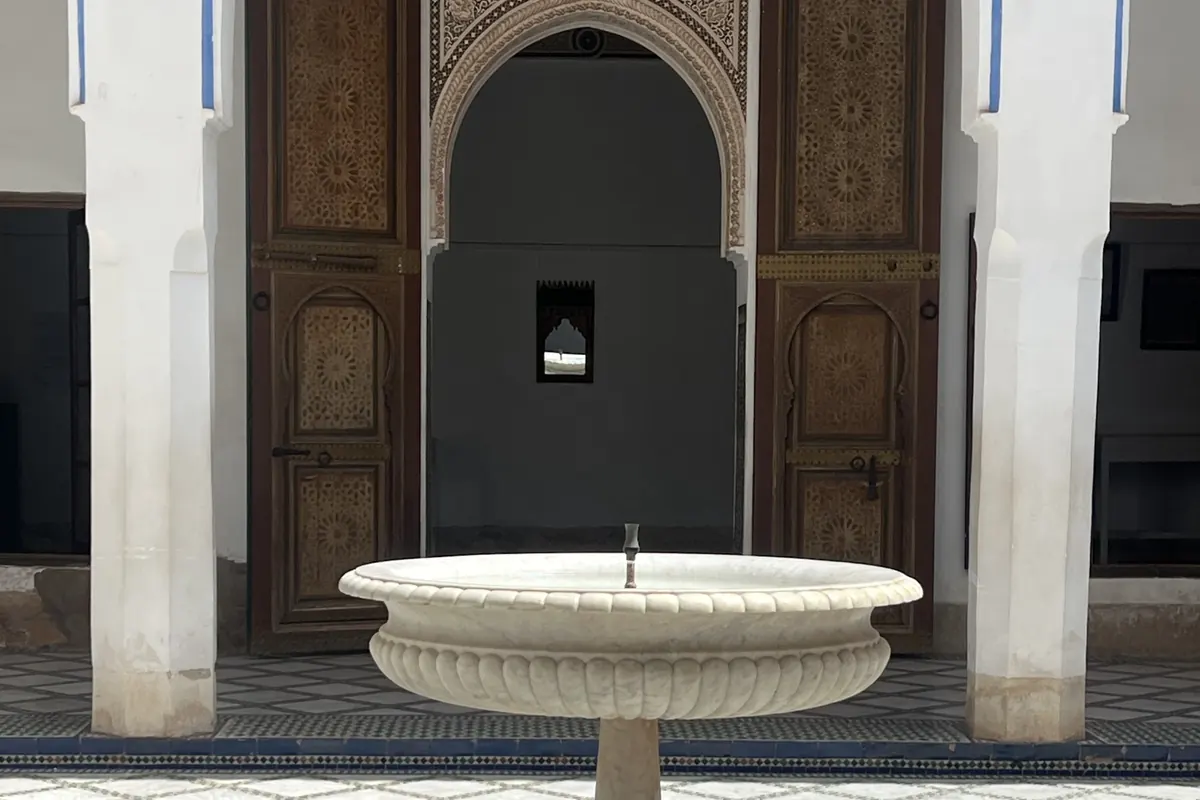
The approach passes through tighter interiors, so the open sky arrives suddenly. Long horizontal arcades pull the eye around the perimeter while the fountain fixes the centre. The contrast is deliberate and makes the court feel even broader.
Where to stand
Begin near the entrance for the full axial view, then move toward a corner. From the side, repeating arches compress into a dense pattern and the painted timber becomes easier to read. The fountain works best as an anchor rather than the only subject.
What to notice
Look past the scale to the joins between materials: marble against zellige, slender columns beneath decorated wood, blue and yellow paint under the green roofline. These transitions show how separate crafts were coordinated into one room without a ceiling.
Where the size and date come from
Official restoration documentation identifies this space as the Grand Marble Courtyard and lists the Salle d’Honneur as a distinct principal component. The size, date and marble given elsewhere in this guide, about 50 by 30 metres, 1896–97 and Carrara marble, come from Gaston Deverdun’s 1959 history of Marrakech, cited in Wikipedia, not from an official survey.
The courtyard belongs to a sequence rather than standing alone. Its hard open surface and ceremonial scale contrast with the planted riads, helping visitors read the shift from shaded residential courts to a more formal reception setting.
Current restoration records also show that the Grand Marble Courtyard is an active conservation area. Protection of finishes, roof work and structural consolidation mean that access and visible details can change without altering the courtyard’s historical importance.
Questions visitors ask
Is the Grand Courtyard the same as a riad?
No. It is a predominantly paved formal court, while a riad is organised around a planted interior garden.
Is every published measurement reliable?
Treat it with care. The size given in this guide, about 50 by 30 metres, comes from Deverdun (1959), cited in Wikipedia, not from an official survey.
Can restoration change the visit?
Yes. Conservation work and operational needs can alter circulation or temporarily obscure details.