Updated · How we check facts
First 30 minutes: read the entrance sequence
Move through the first rooms and thresholds at a steady pace. Notice how painted cedar, carved plaster and zellige work together, but save long photography stops until you understand the route and crowd flow.
Next hour: main rooms and Grand Courtyard
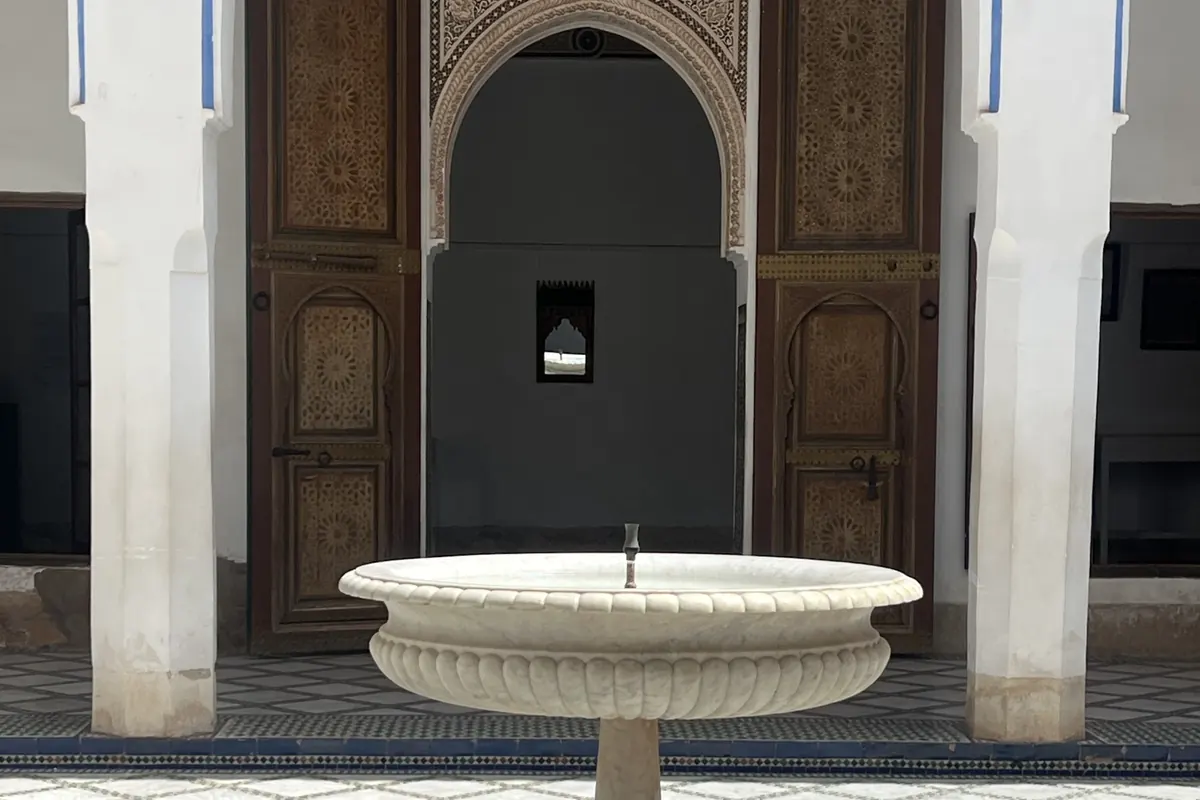
Give the central hour to the decorated reception spaces, smaller riads and Grand Courtyard. Change viewpoints, look back through doorways and compare intimate planted courts with the scale of the paved ceremonial courtyard.
Final 30 minutes: details and a quiet pause
Return your attention to one ceiling, one plaster panel and one zellige composition. Finish in a garden court when access allows, then follow the current exit route rather than trying to retrace every room.
What two hours add
Two hours let you read the palace in the order it was built, whatever order the open route takes you. The oldest part is the Grand Riad, Si Moussa’s house of 1866; Ba Ahmed’s additions of 1894–1900 are the Petit Riad, the small marble court, the private pavilion and the Grand Courtyard.
Look for the two dates the building carries itself: 1866–67 in the halls beside the Grand Riad garden, 1896–97 in the Salle d’Honneur.
The Ministry lists marble, mashrabiya, zellige, stained glass, carved and painted wood and stucco across the four main courtyards. With two hours, pick one of them and follow it from room to room.
Two hours also leave time for a second monument nearby: El Badi is about 10 minutes on foot. Walking route →
Questions visitors ask
Is two hours too long for Bahia Palace?
No, if you want the craft and the history; most visitors need 60–90 minutes.
What is the oldest part of Bahia Palace?
The Grand Riad, Si Moussa’s house of 1866.
Can I combine Bahia with another monument in a morning?
Yes. El Badi is about 10 minutes on foot.