Updated · How we check facts
First 15 minutes: enter slowly
Use the entrance sequence to understand the palace’s scale. Notice the first tiled thresholds and painted wood, but keep moving until the route opens into the early courtyards. Save detailed photography for one or two places.
Next 25 minutes: the main rooms
Give the largest share of your visit to the decorated reception rooms and Grand Courtyard. Step to the side of the visitor flow, look back through doorways and compare the ceiling, plaster and floor as one composition.
Final 20 minutes: gardens and details
Slow down in a garden court or smaller riad. Choose one ceiling and one zellige panel to examine closely before following the exit route. This final pause is usually more rewarding than rushing back to repeat a photograph.
What to see in the hour
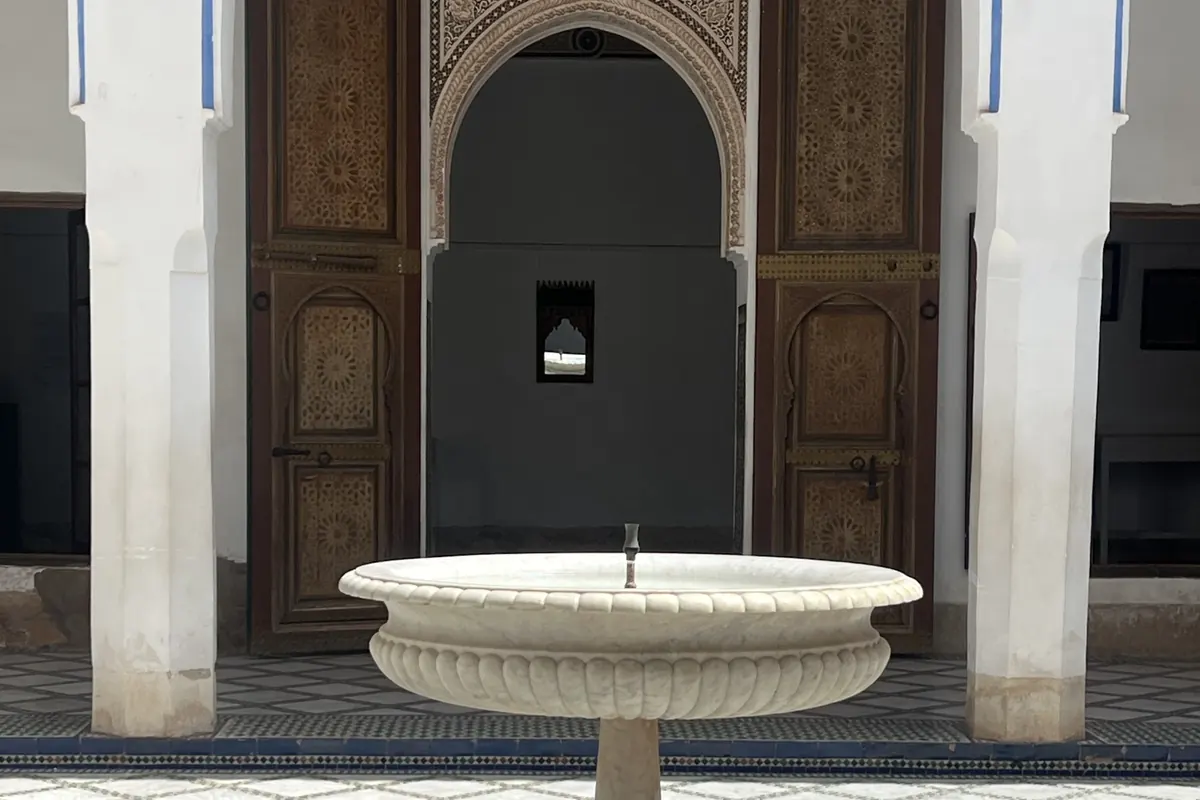
The Grand Courtyard. If you see one space, make it this one: 50 by 30 metres, paved with Carrara marble and framed by a colourful wooden gallery, dated 1896–97.
The Salle d’Honneur. At the courtyard’s east end; its ceiling holds some of the best painted decoration in the palace.
The Grand Riad. Si Moussa’s house, the oldest part: a garden still planted with trees from the nineteenth century, and halls dated 1866–67 by an inscription.
Timing. The palace is open from 9:00 to 17:00 and the Ministry publishes no last-entry time. Arriving by 16:00 leaves you the full hour.
Questions visitors ask
Is one hour enough for Bahia Palace?
For the main spaces, yes: the Grand Courtyard, the Salle d’Honneur and the Grand Riad. Allow 60–90 minutes for a calmer visit.
What time is last entry at Bahia Palace?
The Ministry publishes none. The palace closes at 17:00.
What should I not miss in one hour at Bahia Palace?
The Grand Courtyard.