Updated · How we check facts
Why pair it with Bahia
At Bahia, craft remains attached to rooms and courtyards. At Dar Si Said, museum displays can help you examine materials and objects more closely and connect architecture with furniture, woodwork and personal adornment.
Plan a focused museum visit
Before setting out, check whether the museum has reopened after its post-earthquake restoration, and its hours. Once inside, give priority to a few objects and their labels rather than rushing through every case.
Use the walk between sites
The short route keeps the day centred in the southern Medina. Add the Mellah or Place des Ferblantiers if time allows, but avoid stacking so many interiors that the objects begin to blur together.
The house of Ba Ahmed’s brother
The house was built between 1894 and 1900 for Si Said ibn Moussa, Ba Ahmed’s brother, a vizier and minister of war under him. It is Bahia’s exact contemporary, built by the same family in the same years.
It became a museum of Moroccan arts in the early 1930s and reopened in June 2018 as the National Museum of Weaving and Carpets, run by the Fondation nationale des musées.
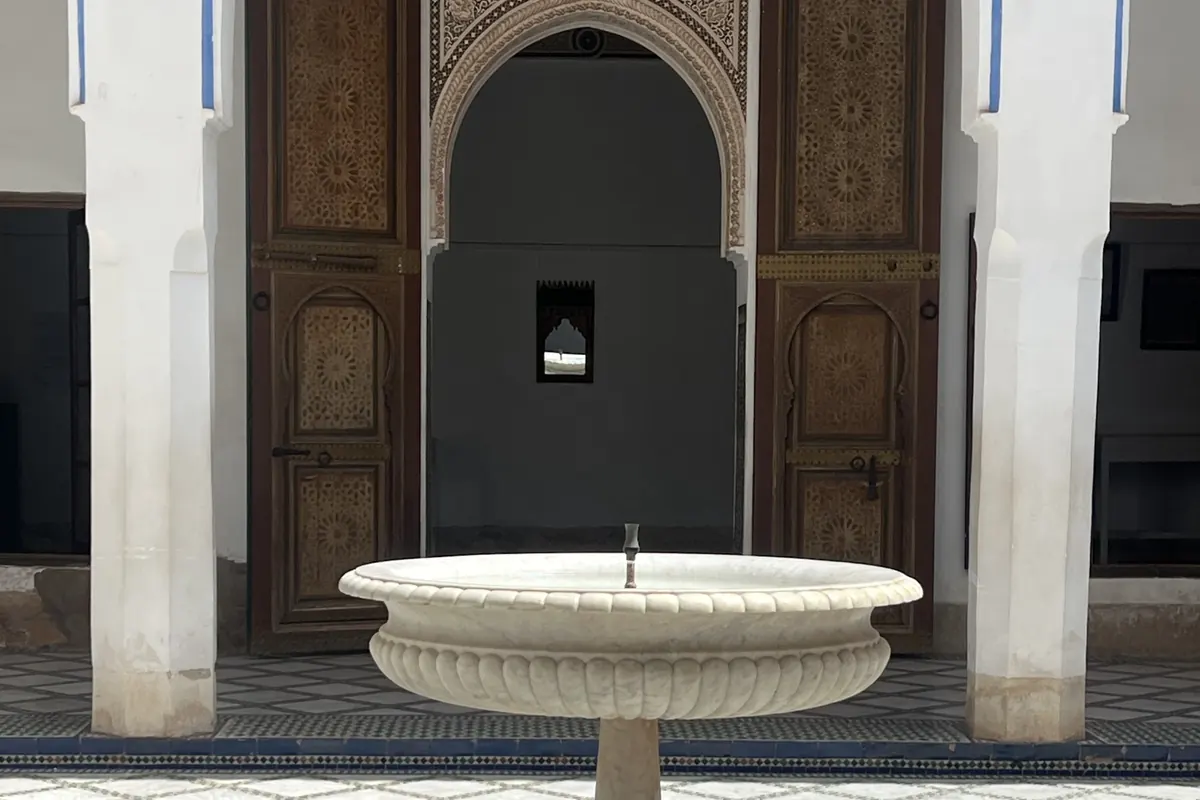
Its best-known object is older than both houses: a marble basin made in al-Andalus, at Madinat al-Zahra, between 1002 and 1007, and later reused in the Ben Youssef Madrasa.
The September 2023 earthquake damaged the building significantly and it closed for repairs. In April 2025 the Moroccan press reported that its restoration was starting. Check its status before you go.
Questions visitors ask
Is Dar Si Said open?
It closed for repairs after the September 2023 earthquake. Check whether it has reopened before you go.
Who was Si Said?
Ba Ahmed’s brother, a vizier and minister of war; his house was built between 1894 and 1900.
What is Dar Si Said today?
The National Museum of Weaving and Carpets, run by the Fondation nationale des musées.